
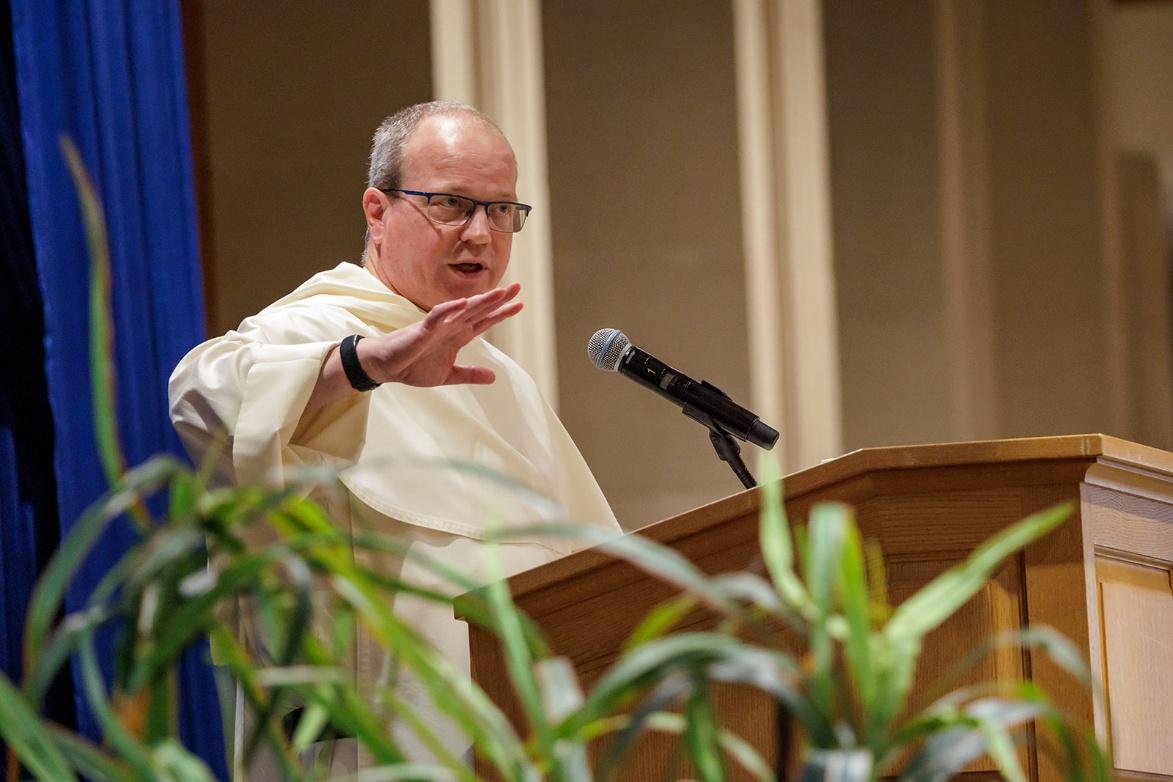
Interview with Thomas Joseph White OP
2 October 2026 – Notre Dame University
1. The revival of faith and theology
Interviewer: First question: the revival of faith and theology. Following his recent trip to France, the Holy Father spoke of a rebirth of the Church, and the media has been noting a Catholic revival in parts of Europe and the USA. In your lecture yesterday at Notre Dame University (Beauty, Wisdom, and Christ), you pointed out a very encouraging trend: increasingly, more young people are enrolling in theology programs. Do you think we are witnessing a true theological resurgence? And if so, to what do you attribute this thirst among young people to understand their faith so deeply?
Father Thomas Joseph White OP: I think what we’re seeing is a resurgence of interest in classical theological voices: the Fathers of the Church, the great medieval thinkers, and even some rather classical modern thinkers like John Henry Newman, Matthias Scheeben, or Charles Journet.
And the reason we’re seeing this, I think, is because there’s a sentiment of rootlessness in the culture and a desire for perspective. People are seeking to find fundamental reference points to re-center thought on ultimate questions, and trying to find a basic intellectual orientation. This is a normal thing to happen after the radical destabilization of human intelligence in the wake of post-modernism and scientism. People are looking for some kind of fundamental explanation of reality. In the Church, there’s also a sense of instability and the question of what really remains. And so, after the turbulence of recent decades following the Second Vatican Council, you see a desire to find some kind of voice of tradition that would be enduring.
This can lead to tradition. But it can also lead to an artificial traditionalism that’s superficial or historically un-nuanced, or to a kind of fear of trends of knowledge that could threaten tradition. By contrast, a deep understanding of tradition allows you to see living principles that endure, what John Henry Newman called “chronic vigor”: the chronic vigor of the intellectual tradition of the Church. And it allows you, out of that depth of knowledge and that stability of understanding, to engage with contemporary questions. I think it’s the intuition of seeking something like that which is animating many young people as they engage in the study of theology today.
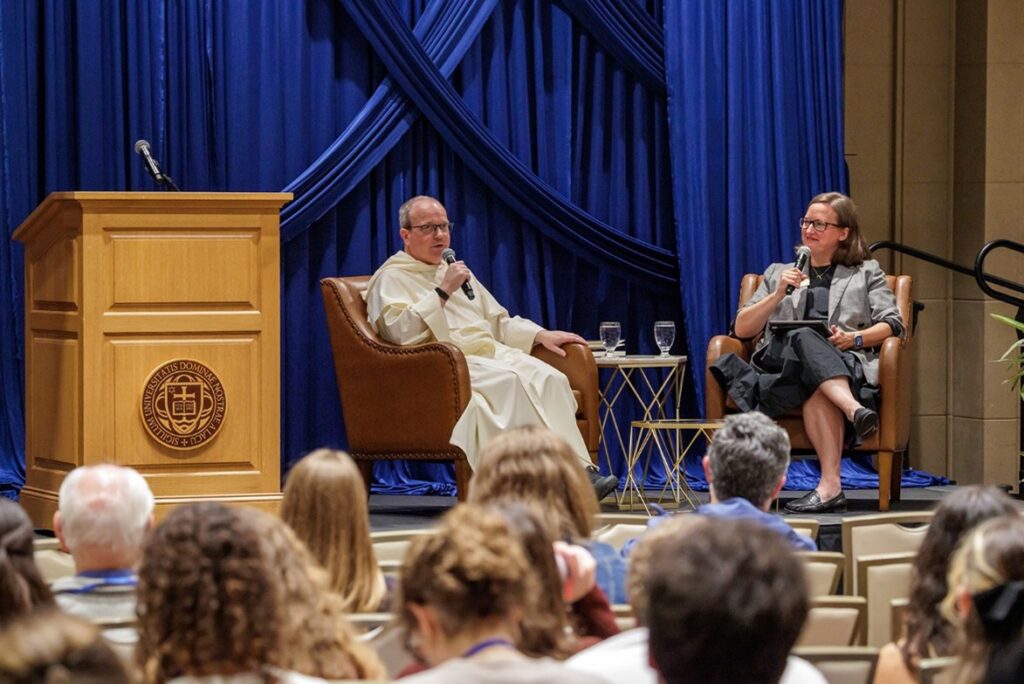
Interviewer: As one of the best-known theologians in the Church and a member of the International Theological Commission, what do you think will be the direction of theology in the next hundred years?
Father Thomas Joseph White OP: Well, a hundred years is too far in the future for me. I would only say that I believe we’re going to see a continued interest in traditional resources for the foreseeable future. For example, the study of St. Thomas Aquinas is, in my judgment, ascendant in the English-speaking world. This is not the case on the European continent in the same way. You see a little bit of this in the Spanish-speaking world, but in general, on the continent, there’s still the idea of working out of—let’s call it—the postmodern paradigm, or from modern resources, such as engaging with Kant and Heidegger. There’s not a new confidence in the recovery of pre-modern voices to the same degree as in the English-speaking world.
That trend in the English-speaking world is providing a kind of ballast or stability to theology, though perhaps also a provocation. I think the real question will be what happens with European continental theology and what happens in the new Churches of the Global South. There’s a line of thinking that wants to promote what we could call contextual theology: a kind of revisionist ethics, a post-colonial, perhaps Marxian—not Marxist, but Marxian—dialectical theology about power and the redistribution of power in the Church. I do not believe that that voice is going to sustain a deep renewal of the Church’s inner spiritual life: a renewal that takes place at a deeper level than the political level, at the sacramental and the mystical level, and by a deep engagement with what we might call core metaphysical themes.
What is the meaning of human existence? Who is God? Who is Christ? What is grace? In the next generation, those questions are going to be pursued by people studying classical figures like Augustine, Thomas Aquinas, Bonaventure, and Newman. The alternative to that—or the next revolution, so to speak—is unforeseen, but I think it’ll be some kind of synthesis: people will try to take tradition and re-engage with contemporary philosophy and secular culture in some kind of middle term. I’m not saying that I approve or disapprove of any of this; I’m just making a little prediction.
2. Thomas Aquinas and the Early Christians
Interviewer: Thomas Aquinas is often associated strictly with the Middle Ages. For our readers at Primeros Cristianos: to what extent is Thomistic theology actually a maturation of the Church Fathers’ thought, and why do the answers provided by those early councils remain vital today?
Father Thomas Joseph White OP: I think that Thomas Aquinas is one of the great inheritors of the thought of Augustine. He’s arguably the greatest Augustinian thinker, the most proficient. He’s probably the most profound interpreter of Augustine: certainly a controversial interpretation, because he uses Aristotle, but I think ultimately probably the most full and rich interpretation. Secondly, in Christology he is at the school of the Greek Fathers, deeply influenced by Cyril of Alexandria, by Dionysius the Areopagite, and by John of Damascus.
In a way, it’s hard to make the Fathers current or relevant to the world today without passing through the scholastic reception. Consider the magisterial reception that someone like Augustine gets later at the Council of Trent: what cooperative grace looks like—Augustinian cooperative grace, which works through the sacraments that sanctify us—or operative grace, which restores us to grace or provides grace after original sin, after the fall: baptism, confession. To understand Augustine in light of the Council of Trent, you need the scholastic reception of Augustine. You can’t just take Augustine and the Council of Trent without something like scholasticism.
Or you can ignore the Council of Trent and read Augustine. But you can’t really be a modern Christian, after the Second Vatican Council and the Catechism of the Catholic Church, without the Council of Trent. You can’t understand what the sacramental life is without Trent. It’s just an example. You can’t receive Vatican II without Vatican I and its doctrine on papal primacy. And you can’t receive the doctrine of Revelation in Dei Verbum without the doctrine of Revelation in Dei Filius. But to receive Dei Filius, from the 19th century, is to engage with scholastic thinking about faith and reason. If you want to do that elegantly and profoundly, you need something like Thomas Aquinas as part of the story.
Now, the delusion of the Europeans, which is very grave, especially in the Spanish-, Portuguese-, Italian-, and French-speaking world—the Romance-language world—is to think Thomas Aquinas is irrelevant. This is due to the radical self-doubt of the Catholicism of these cultures, which lack inner conviction about their own heritage and its nobility. So we relegate Thomas Aquinas or Bonaventure, these great figures, to archaeology: to historical figures, to exemplary lives of faith and reason from the past. We think they represent monuments of culture. And meanwhile, we treat Derrida, Althusser, Kant, or Heidegger as if they had the last and final word in philosophy. This is actually a kind of pusillanimity.
It’s an intellectual sin, a pusillanimity which animates the European spirit, I think, in ways that are very unhelpful. Because the truth is that these great figures of the Christian past and of the pre-Christian Hellenistic past remain as great as the greatest we’ve ever had in the intellectual life. To say that today may seem superficial, lacking sensitivity to the great challenges of Kant, Hume, Hegel, Nietzsche, Freud, and so forth. But actually, if you really engage with all those modern figures—to whom, I would dare say, in English-speaking universities we are exposed first—once you’ve done so, even before the others, and then you go back to Aristotle, Augustine, or Thomas Aquinas, you see that they simply are superior.
What we lack is the courage to take the great knowledge of these figures of the past and engage with it today dialectically in a deep dialogue, in the Aristotelian sense, on the fundamental questions we face in the light of modern science and modern philosophy, and to really rethink the heritage of the past, classical wisdom. If we do this loyally, Thomas Aquinas is formidable. Because of his philosophical understanding of human logic and of the procedures of dialectic and demonstrative argument; his understanding of what science really is and what the discipline of the study of a body of knowledge is; his understanding of human epistemology and his grasp of human nature; his thought about the human moral life and what the intellectual, moral, and artistic virtues are; his understanding of the deep metaphysical grounds of human knowledge and ethics; his understanding of the harmony between faith and reason, and his understanding of the rational viability of belief in God, as well as the rational grounds for welcoming divine revelation.
He’s really a fundamental figure of insight, of perduring relevance. Saying that today sounds like a kind of… I mean, you’re often accused of some kind of fundamentalism. But that is ridiculous. It’s not an accident that figures like Paul VI, John Paul II, and Pope Francis have told us that Thomism has an enduring legacy. Failing to engage with it as a living form of thought makes the Church’s intellectual life anemic. So instead of becoming relevant, we make ourselves progressively irrelevant. Because if we’re just another second-rate phenomenologist or a second-rate analytic philosopher who is parroting our peers to receive social acceptance in the university, but we’re not figures with a real understanding of the wisdom from the past, we have nothing to offer the intellectual life of the world today.
We should seek to be great phenomenologists and great analytic philosophers. But we should seek, above all and first, to really be stewards of the traditions of wisdom, which I hold are unsurpassed. I stand with people like Paul VI and John Paul II in thinking that the wisdom of the past retains a perpetual actuality and relevance. And I think that a culture that fails to see that is a self-destructive culture. It’s a culture of despair and, ultimately, a culture that will disappear. Sociologically, the Church will only be sustained by people who believe in her vitality. And those are the people who…
It’s very much like human life. Only people who believe in human life transmit human life. Only people who believe in the patrimony of Catholicism transmit the patrimony of Catholicism. A self-sterilizing Catholic intellectual tradition is unfolding in front of us, and I think it’s going nowhere. So I am very critical of all that. But I really believe that we have a great promise and a great hope before us. And it’s because of my optimism that I’m also issuing a kind of challenge: to reverse course from our despair, our self-doubt, and our pusillanimity, and to embrace magnanimity, hope, and a genuine engagement with the past, which, if rightly conducted, is in my judgment a true engagement with the future.
3. The need for metaphysics
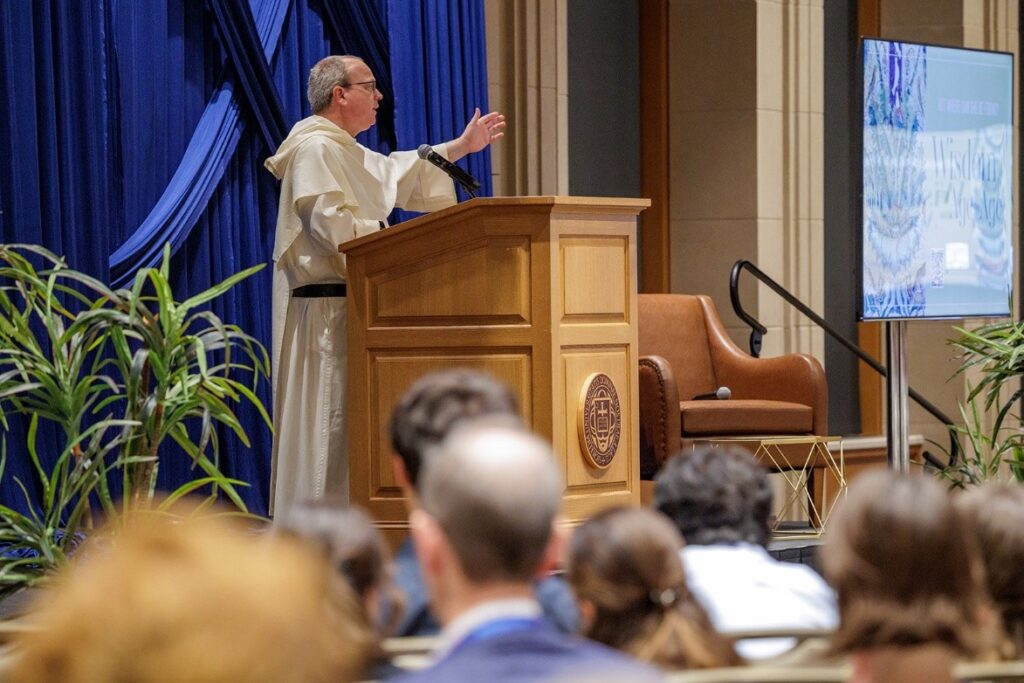
Interviewer: The need for metaphysics. Yesterday, at the opening of the Fall Conference at Notre Dame University, you raised a very interesting point: rather than focusing on apologetics, there is an urgent need to form young Catholics in metaphysics, because without it, it’s impossible to truly understand the faith. Could you expand on this idea? Why is metaphysical thinking so fundamental for believers today?
Father Thomas Joseph White OP: I think we’re facing a moment of deep intellectual disorientation. The conventional stewards of our intellectual life have been for decades certain reference points: especially post-Kantian cosmopolitan liberalism, the rise of postmodern theory, or the rise of scientism, based on a confidence in the modern sciences as the privileged locus of knowledge; and, to some extent, Marxism, which has been one of the chief vehicles for advancing an ethical understanding of history and of economic and social relationships in past generations. All of that, I think, is today failing to gain traction as a viable way of thinking about our situation.
And what you see arising then is tribalism: nationalist tribalism, regionalist tribalism, and a kind of nostalgia for local tradition—local in a broad sense—, for national patrimony. That’s not a vehicle capable of sustaining meaning. Ultimately it’s rather arbitrary, and also conventional. It’s the hope that in the conventions of our national patrimony there might be some non-negotiable truths and values that we intuitively uncover or could recover. That’s insufficient. So you don’t really transcend all of these challenges unless you get back to the real question of what reality is. What is it to be a human being? What does existence mean?
Is there a goodness that precedes the constructivist judgments of the human mind? Meaning, is ethics a matter of sheer will to power or constructivism of human society? Or is it based on the goodness of a nature that precedes us and that we know how to appreciate? Are moral beauty and aesthetic beauty written into the very structure of things? Or is beauty a completely subjective project, which, I think, is ultimately a kind of perspective of aesthetic despair?
I think that young people are realizing more and more that their minds can’t just be used in a utilitarian fashion to pursue the goods of the market. They can’t just be consumers of modern liberal capitalism. They can’t just be instrumentalized by political ideology or fed rubbish through the online talking points of this combat of superficial ideas that comes over us in waves on the internet. And so they’re looking for something deeper to ground them. Of course, there are many victims of superficiality, of the forms of superficiality I’m referring to. But there are also people who emerge from it looking for a deeper metaphysical structure of understanding.
You also can’t really do theology if there’s no way for the human intellect to think about the transcendent mystery of God. And there isn’t if it can’t think metaphysically—and, I would say as a Thomist, analogically—about being, goodness, truth, unity, and beauty. So we need to recover in our thought that metaphysical connection to reality in order to also welcome divine revelation and cooperate with it. Without some metaphysical dimension of reference in the human mind, there really is no sacred cooperation of the intellect with divine revelation: to consecrate the intellect to God so that the heart can follow, to know God so that we can love him. Metaphysics is essential as a dimension of sacred theology. And so I think that the desire to cooperate with the intelligibility of the faith implies, ultimately, an openness to metaphysical questions.
4. As in early times, evangelizing a post-Christian culture
Interviewer: The early Christians evangelized a Greco-Roman culture that considered their faith to be foolishness. Today we face a post-Christian culture. How should a Catholic today integrate reason and science, and engage with modern skepticism, without watering down the faith?
Father Thomas Joseph White OP: I have several thoughts about that. First of all, I’d say that evangelization is an art, not a science. Although it makes use of science—of historical, intellectual, philosophical, and theological knowledge—, there’s an art to talking to people based on where they are and who they are, to listening to them and trying to understand them. And you can’t master this art on the first try. You master it by a lifetime of practicing it, as you would with a musical instrument. You become more skilled, more adept at the art of evangelization, which consists in seeking the good of the other person. To love is to will the good of the other. To evangelize is to will the good of the other.
And it’s also a kind of confidence in oneself before God as a purveyor of the truth, as a servant of the truth. Servant, not master. So I think it’s about becoming a certain kind of person, listening to other people, and seeking to love them and help them. And you can’t be afraid to fail. If you don’t start, you won’t succeed. If you start, you will fail before you succeed, or you will sometimes fail. So we have to get over discouragement and self-consciousness. It’s too important a project.
I think talking about happiness is one of the most important starting points. People realize that happiness is something essential to pursue and difficult to find. And as Catholics, we come from a tradition that teaches that happiness can be found, and that teaches us how to achieve it, even under duress or in the midst of great suffering. What is it to find the happiness of possessing God and of pursuing God, of pursuing the truth and the love of other persons, of pursuing friendship, justice, mercy, and forgiveness? There’s a happiness in Catholicism. And I think that’s something we should be able to talk about philosophically and theologically.
I think we should also try to depict our own intellectual stance today as post-cynical—that is, as a stance that leaves cynicism behind. Following the disillusionment that came after the collapse of Marxism, many intellectuals in Europe are faced with deep cynicism. Strangely as it may sound to Catholic ears, for many Marxism was an idealistic movement. So when the intellectual class failed to achieve what they considered a superior regime—let’s call it moderate socialism, the moderate socialism of Western Europe, a mix between the American side and the Soviet side—, they fell into the rut of cynicism and resignation to the rise of a capitalist culture that, in their judgment, has no transcendent values.
We need a post-cynical approach to re-engage with the fundamental questions of Western civilization that arose in the patrimony of Hellenistic philosophy. Very basic questions that are already there in the tragedians, in the pre-Socratics, in Socrates, Plato, and Aristotle: renewing an alliance with the deep questions about truth, justice, and goodness. And then seeing in the Fathers of the Church, like Augustine, a deep engagement with that Hellenistic philosophy. I think Thomas Aquinas is one of the great masters of this, but there are also many great modern voices who teach us to courageously believe in the greatness of the human soul.
The greatness of the human soul’s questions and its search for meaning: to not see it in a cynical or despairing way, but in a post-cynical and actually fresh, new way, as a pathway to think that there’s a quest for the truth, that there’s a quest for God, and that Christianity is a way. That’s what it was called early on: “the Way.” Orthodoxy is, so to speak, a straight path; that’s what the word tends to denote. So we’re looking for the straight path toward the truth, toward the good, and to possess the beautiful. I think that talking about that with people in a post-cynical way is key to evangelization.
5. Beauty, art, music and popular culture
Interviewer: The early Christians used symbols and beauty to transform their surroundings. You are not only a theologian, but also a banjo player for the Hillbilly Thomists. What role do art, music, and popular culture play today in the mission of drawing hearts to Christ?
Father Thomas Joseph White OP: Well, let me say a grand thing and then a simple thing. The grand thing I’d like to say is that the recovery of virtue ethics in modern philosophy has been pivotal for recovering a deeper way of thinking about ethics. Even among many secular people, a consensus has been reached that we need to think about virtue theory. I think we can recover a deeper sense of metaphysics by talking about natures and properties, about existence, and about the metaphysical grounds of ethics.
What we haven’t done as much is think about the metaphysics of beauty and how art invites a person to gaze on the world as meaningful. The natural beauty of the world precedes artifactual beauty, and the latter pays homage to natural beauty. That play between natural beauty and artifactual beauty is a play between what God has given us and what human beings then take from it to magnify the beauty of creation or point toward it, as a way of thinking about the beauty of the human soul and doing reverence to what God has given us in the world. So I think beauty should be more in the vanguard of the Church.
And I think it should affect the sacred liturgy, whichever form of the Mass we are celebrating. But also common human culture. Irish folk music in the 19th and 20th centuries sustained the Irish under great political pressure and gave them a Catholic form of—I would call it—elevated common social life: through Irish dancing, through the Irish celebration of life, and the mourning of sorrows, of the sorrowful elements of life. That mixture of mirth, comedy, and tragedy that sustained a culture under duress back in the 19th and early 20th centuries. So music is one example of how we can have high, solemn forms of music, but also, you might say, music for ordinary time, music in ordinary life.
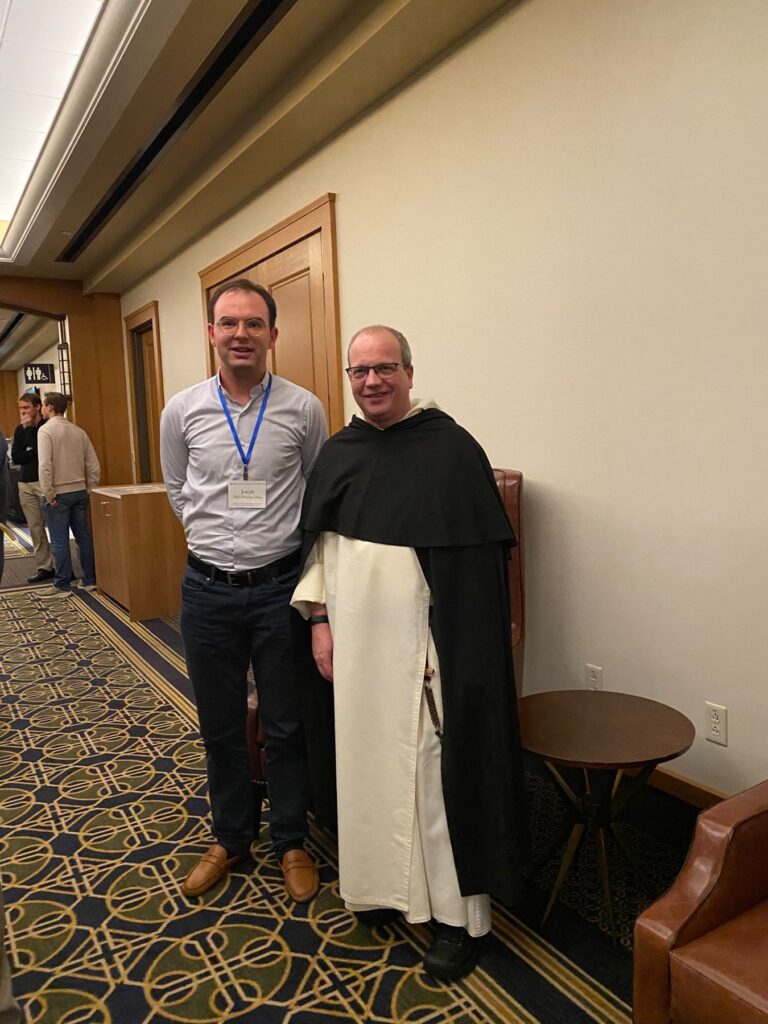
And the simple thing I would say about music and my own experience with it is that I don’t seek to write or play music primarily to evangelize. I play it to celebrate human existence. And it’s playful: a delight in just being, in playing with the qualities of music and of the instruments, in enjoying playing with other people, in humor, in celebrating the humorous, and also in mourning, playfully, the tragic dimensions of human existence. And I would say not at a very professional level, nor in a particularly sublime or sophisticated way. But I think that learning to do that, to celebrate ordinary life musically, is a way in which I end up exploring religious ideas: not exactly by accident, but as an outcome of thinking about what it means to be a human being, simply through the perhaps modest format of popular music.
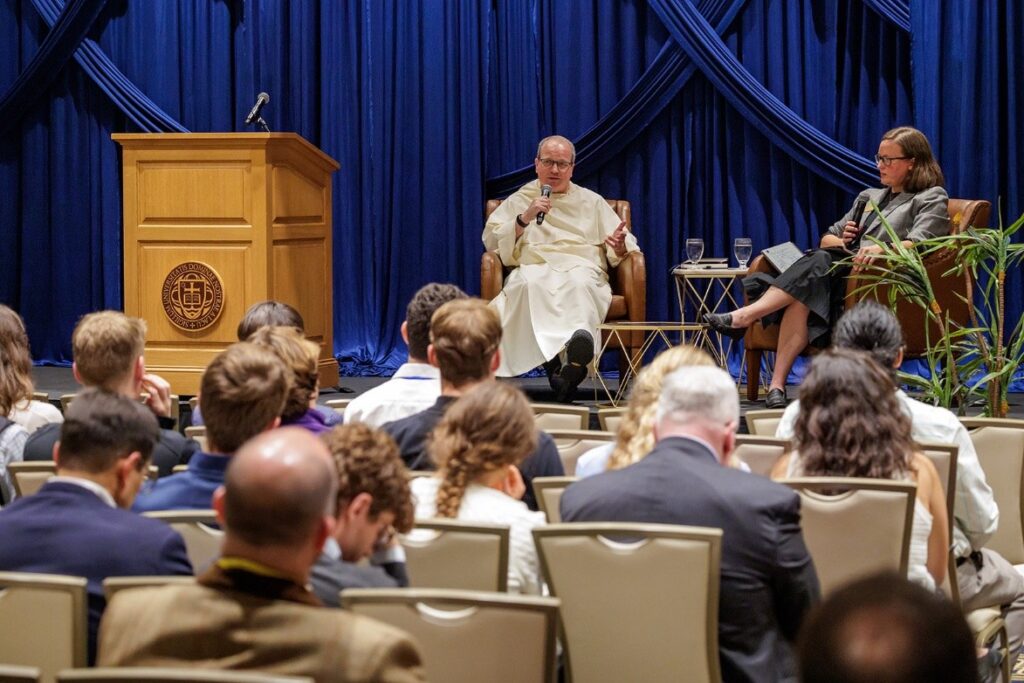
Interview in English conducted by Josep del Hierro Dies, at the 2026 Fall Conference of the de Nicola Center for Ethics and Culture at the University of Notre Dame, directed by Jennifer Newsome Martin.
Photographs courtesy of the de Nicola Center for Ethics and Culture, photographer: Peter Ringenberg.

 Loading...
Leave A Comment
You must be logged in to post a comment.